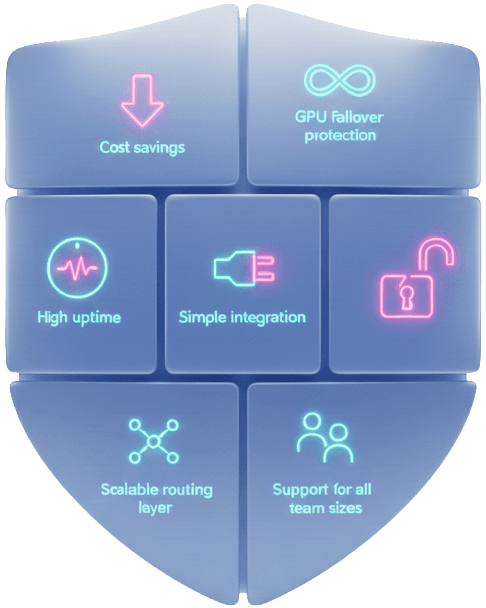
A faster, cheaper and morereliable way to run AI
1. Up to 60-80 percent cheaper than major clouds
Cloud GPUs stay expensive because you pay for fixed infrastructure, idle clusters and centralized overhead. OpenGPU avoids this by routing workloads across a live global pool of decentralized providers, datacenters, enterprise operators and cloud overflow so you only pay for compute that is actually used.
Relay customers typically save 60-80 percent compared to traditional clouds on equivalent workloads. OpenGPU blockchain users, who pay directly on chain, can save even more.

No idle clusters
Routing pulls from live capacity across the network so you are not paying for idle GPU fleets.
Lean overhead
Decentralized providers and datacenters reduce heavy centralized overhead that inflates cloud pricing.
Native or Relay
Use Relay with fiat and HTTPS or native OpenGPU execution on chain to access even lower pricing.
2. Routing first, not datacenters
Traditional clouds start from infrastructure and regions. OpenGPU starts from a routing layer that treats all compute as one pool then decides where each workload should run in real time.



Signals from the network
VRAM and GPU class, node health, utilisation, latency and geographic proximity, all evaluated per job.

Signals from the workload
Model type, memory needs, expected duration, budget and priority determine where each job should land.

Routing goal
Match every job to the best available GPU at that moment so you get strong performance without building your own scheduler.
3. Jobs do not restart if a GPU fails mid run
On many clouds a failing instance means restarting your workload unless you build your own checkpointing and recovery. OpenGPU is designed to keep jobs moving even when individual nodes are unreliable.


Live health checks and failover
Routing monitors provider health. If a GPU drops or underperforms the job is shifted to the next best node without restarting from zero.

Single executor with continuity
Each workload runs as a single logical executor with checkpoints and continuity guarantees so long running training, video and scientific jobs can complete without duplicated cost.
4. Built to never go down
like a single cloud region
The network combines decentralized providers, datacenters, enterprise fleets and cloud overflow so that no single facility represents a single point of failure.
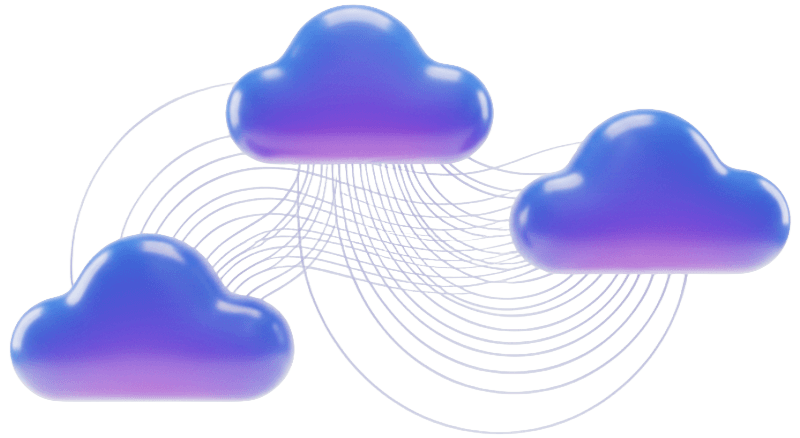


Global mesh of providers
If one region is under pressure routing simply shifts new jobs to healthy nodes elsewhere.

Datacenters plus community
OpenGPU operated datacenters provide a stable backbone while decentralized providers add elasticity.

Cloud as overflow
Cloud GPUs can be used as overflow capacity for rare GPU types or extreme demand spikes.
5. No long term contracts
OpenGPU is usage based. There are no reserved instance lock ins, no minimum spend commitments and no multi year contracts. Teams can ramp up or down with demand and only pay for workloads they actually run.

6. OpenGPU Relay Pricing
Relay exposes the network through a simple HTTPS endpoint with fiat billing. Pricing is already more than 50 percent cheaper than centralized services on average and many workloads land in the 60-80 percent savings band compared to major clouds.

7. One network for every workload
- LLM inference and training
- Multimodal and embeddings
- Video AI and transcoding
- VFX rendering and CGI
- Scientific and research compute
- RAG and agent workloads
- Batch processing and cron jobs
- Synthetic data generation

8. Why teams switch from centralized clouds to OpenGPU
- 60-80 percent lower costs for many AI workloads.
- Jobs do not restart if a GPU fails mid run.
- Strong uptime because the network never relies on a single region.
- Simple Relay integration with HTTPS and fiat billing.
- Even lower prices with native OpenGPU on chain execution.
- No long term contracts or reserved instance lock in.
- One routing layer that can grow with your workloads.
- Support for both startups and large enterprises.