How workloadsmove acrossthe OpenGPU Network
How OpenGPU Connects your AI to global GPUs
OpenGPU automatically routes each workload to the best available GPU across the network, balancing speed, reliability and cost with built-in failover and retry mechanisms.


Step 1 · Submit a workload
Workloads are submitted via Relay (HTTPS, fiat billing) or native OpenGPU tools. Execution requirements like GPU type, VRAM, model, and runtime constraints are defined upfront.

Step 2 · Intelligent routing
The OpenGPU routing layer evaluates the global pool of GPUs that meet those exact requirements and determines the optimal execution path, balancing performance, reliability, and cost. No manual provider selection. No marketplace decisions.

Step 3 · Execute end to end
Tasks run with real-time logging, verification, and result delivery. Built-in retry and failover ensure continuity if a node drops, without breaking execution guarantees.
The Routing Layer
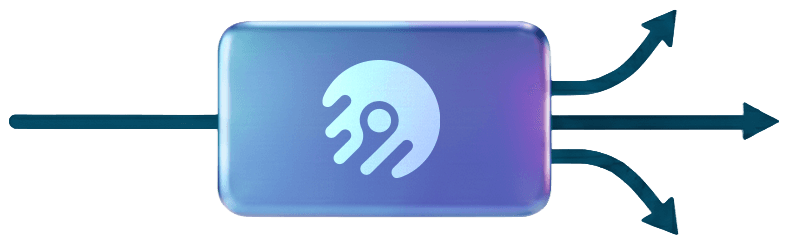
The routing layer makes OpenGPU intelligent. It evaluates every signal from the network and each workload to decide where jobs should run.
Network Signals
VRAM, GPU class, latency, reliability, utilization and node health.
Workload Signals
Model type, memory needs, budget, duration and priority level.
Routing Goal
Match each job to the best GPU at that moment without manual scheduling.
Hybrid Global GPU Network
OpenGPU blends decentralized providers, datacenters, enterprise clusters and cloud GPUs into a single logical network.



Decentralized Providers
High-throughput and cost-efficient GPU nodes from global operators.

Datacenters
Enterprise-grade clusters offering stability and predictable performance.

Enterprise + Cloud Overflow
Reserved enterprise nodes and cloud GPUs for special requirements.
Ready to explore global workload routing?
Learn how OpenGPU moves compute across decentralized and enterprise nodes.
Explore Enterprise